Food Contact UV Adhesive vs Instant Adhesive: Which Passes Migration Testing More Easily?
Adhesive selection for food contact applications hinges on migration testing. UV adhesive or instant adhesive — which one passes more easily? There’s no absolute answer, but we can make a judgment based on two dimensions: curing mechanism and sources of migration risk.
This guide uses a “problem + market context + solution” approach, combined with ODAKE’s certification data for both product lines, to give you a practical selection logic.
1. The Problem: What Does Migration Testing Actually Measure?
Core Indicators of Migration Testing
Migration testing for food contact adhesives focuses on two categories of indicators:-6
| Test Item | Meaning | Risk Source |
|---|---|---|
| Overall Migration | Total non-volatile substances released into food simulants | Unreacted monomers, additives, solvent residues |
| Specific Migration Limit | Release of specific harmful substances (e.g., primary aromatic amines, formaldehyde, heavy metals) | Raw material impurities, curing by-products |
Migration Risk Differences Between UV and Instant Adhesives
The two have completely different curing mechanisms, which determine different sources of migration risk:
| Comparison | UV Adhesive | Instant Adhesive |
|---|---|---|
| Curing Trigger | UV light irradiation | Trace moisture in air |
| Curing Speed | Seconds to tens of seconds | 3-20 sec fixture |
| Curing Completeness | Shadow areas may remain uncured | Fast surface cure, deep cure may be incomplete |
| Primary Migration Risk Source | Photoinitiator residues, unreacted monomers | Unreacted cyanoacrylate monomers, bloom volatiles |
| Key Compliance Documents | Migration test report + formulation compliance statement | Migration test report + cure completeness verification |
2. Market Context: Why Migration Testing Matters Now
Stricter Regulations, More Detailed Documentation Requirements
EU 10/2011 sets the overall migration limit for food contact plastics at 10 mg/dm². China’s GB 4806.15-2024 also specifies overall and specific migration limits for adhesives, requiring migration testing in actual use conditions covering hot filling, room temperature storage, and other processes.-6-8
“FDA Certified” Does Not Equal “Passed Migration Testing”
Many suppliers cite “FDA certification” as proof of food contact compliance. However, the extraction testing under FDA 21 CFR 175.300 differs from EU 10/2011 migration testing in simulants, test conditions, and limit systems. For EU market access, EU 10/2011 or customer-specified migration test reports are the reference.
3. Solution: ODAKE’s Certification Layout for Two Product Lines
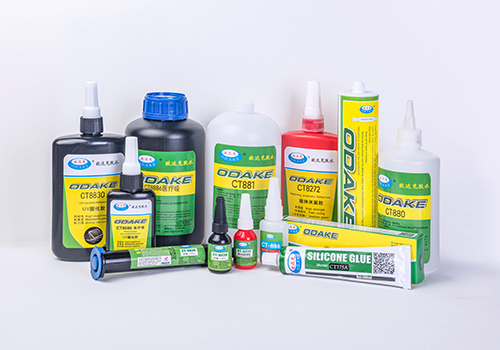
ODAKE offers two product lines for food contact applications, each with a different migration testing strategy:
UV Adhesive Line (CT8886 / CT8887A / CT8888C)
| Model | Viscosity | Key Certification | Application |
|---|---|---|---|
| CT8886 | 3,500-7,600 mPa·s | ISO 10993-5 | Large gap filling, structural bonding |
| CT8887A | 650 mPa·s | ISO 10993-5 | Precision dispensing, small gaps |
| CT8888C | 1,800-2,200 mPa·s | ISO 10993-5 | High temperature (up to 180℃) |
UV Adhesive Migration Advantage: Solvent-free, 100% solid content — migration risk sources are relatively controllable. After curing, a crosslinked polymer network locks unreacted monomers within the adhesive layer, reducing release risk. Key prerequisite: Full cure must be ensured (including moisture cure for shadow areas). Incompletely cured UV adhesive significantly increases migration risk.
Instant Adhesive Line (CT880 / CT892 / CT883)
| Model | Fixture Time | Shear Strength | Key Certification |
|---|---|---|---|
| CT880 | 10-20 sec | ≥28 MPa | Medical grade, food grade, REACH/ROHS |
| CT892 | 10-15 sec | ≥32 MPa | FDA, REACH/ROHS |
| CT883 | 3-10 sec | ≥41 MPa | Food grade, REACH/ROHS |
Instant Adhesive Migration Challenge: Cyanoacrylate monomers have relatively high volatility, which can cause blooming during curing (volatilized monomer reacts with moisture to form white powder). Blooming itself is an appearance issue, but it reflects monomer escape — directly related to migration risk. Low-bloom instant adhesives (such as CT883, CT892) reduce this risk by lowering monomer volatility through formulation optimization.-3-13
Selection Decision Logic
复制
下载
Food Contact Adhesive Selection
├── Is at least one substrate transparent?
│   ├── Yes → UV adhesive viable (CT8886/CT8887A/CT8888C)
│   └── No → Instant adhesive (CT880/CT892/CT883)
├── Are migration test reports available?
│   ├── Supplier provides EU 10/2011 or GB 4806.15 migration data → Proceed
│   └── Verbal "food grade" claim only → Request documentation
└── Is curing process controllable?
    ├── UV adhesive: Confirm shadow areas have sufficient moisture cure time (7 days)
    └── Instant adhesive: Control dispense volume, ventilated environment, low-bloom models
4. Which Passes Migration Testing More Easily?
From a technical principle perspective:
UV adhesive has relatively lower migration risk when fully cured. Reasons: solvent-free formulation reduces volatile organic sources; crosslinked network locks unreacted monomers within the adhesive layer; cured surface is dense with limited release pathways.
Instant adhesive migration risk primarily comes from unreacted monomer escape, especially with incomplete cure or excessive dispense volume. Low-bloom models (such as CT883, CT892) reduce this risk through formulation optimization, but require strict process control.
From a certification documentation perspective:
Both require the supplier to provide migration test reports for the specific product. “Food grade” claims without test data have no probative value in audits. ODAKE can provide REACH/ROHS and food contact-related certification documents for both UV and instant adhesive lines. Specific migration test data should be confirmed based on the target market (EU 10/2011 or GB 4806.15) and customer requirements.
5. Summary
Food contact UV adhesive vs instant adhesive — which passes migration testing more easily? Remember this logic:
UV adhesive: Solvent-free + full cure = controllable migration risk, but must confirm shadow area curing. Instant adhesive: Low-bloom formula + strict dispense control = manageable risk, but monomer escape is an inherent challenge. Both require migration test reports — “food grade” without data is not credible.
ODAKE’s dual food contact product lines cover transparent and opaque substrate assembly needs. For specific product migration test data or compliance documents, contact us for selection support.