Medical UV Adhesive Shadow Area Cure Failure: Causes & Solutions
In medical device assembly for catheters, needles, and sensors, shadow area cure failure of medical UV adhesive is one of the most insidious and dangerous quality problems. The surface may appear cured, but the adhesive layer internally or in light-blocked zones remains liquid — only to fail suddenly during sterilization, shipping, or clinical use.
This guide uses a “problem + market context + solution” approach, combined with ODAKE medical grade UV adhesive product data, to systematically analyze shadow area cure failure causes and countermeasures.
1. The Problem: Why Is Shadow Area Cure Failure Hard to Detect?
How Shadow Areas Form
UV adhesive requires UV light irradiation to cure. When the bonded structure contains opaque substrates (metal connectors, dark plastics) or complex geometries (nested catheters, needle hub interiors), the regions where light cannot reach become “shadow areas”.
Common Failure Symptoms
| Symptom | Consequence |
|---|---|
| Surface cured, interior soft | Tensile test failure, detachment after assembly |
| Shadow area adhesive never dries | Cracking and leakage after sterilization |
| Initial strength acceptable, fails weeks later | Customer complaints, recall risk |
| Fluorescent leak test failure | Batch rejection |
Why Is It Hard to Detect?
Shadow area cure failure is delayed. At initial fixture, the surface may have sufficient strength for production-line inspection to pass. But after autoclaving, alcohol immersion, or long-term loading, the uncured region’s defect becomes exposed.
2. Market Context: Why Shadow Area Problems Are More Prominent Now
Increasingly Precise Medical Device Structures
Catheters have evolved from single-lumen to multi-lumen, from straight tubes to pre-assembled connectors. Needle hub internal structures are increasingly complex. Light reaching every bonding surface becomes progressively harder. Meanwhile, ISO 10993-5 biocompatibility requirements for medical devices limit the available adhesive chemistries — you cannot simply switch to heat-cure or anaerobic systems.
Sterilization Processes Test Adhesive Layer Integrity
Medical UV adhesives must withstand alcohol wiping, radiation sterilization, and steam autoclaving. Uncurred adhesive in shadow areas degrades faster under these conditions, leading to seal failure. ODAKE CT8888 has been validated for alcohol resistance, boiling water resistance, and radiation sterilization resistance — provided the adhesive layer is fully cured.
3. Solutions: ODAKE Medical Grade UV Adhesive Strategies
Strategy 1: Select Adhesive Systems with Shadow Area Curing Capability
Conventional pure UV adhesives cannot cure shadow areas. The solution is a dual-cure system — UV-exposed areas cure rapidly via light, while shadow areas complete secondary cure via moisture or heat.
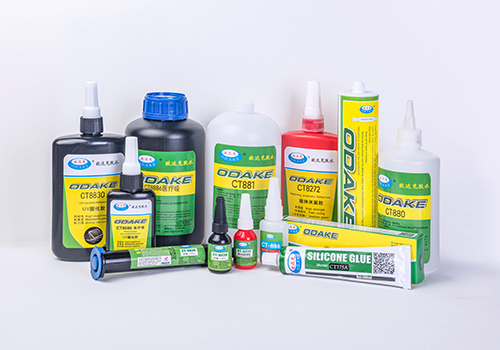
ODAKE medical grade UV adhesive series — CT8886, CT8886A, CT8888, CT8888C — are one-component UV curing systems certified to ISO 10993-5, suitable for catheter, needle, and sensor bonding. For applications with prominent shadow area issues, consider these process measures:
| Measure | Description |
|---|---|
| Extended moisture cure | After UV fixture, shadow areas continue curing via ambient moisture; allow at least 7 days |
| Multi-angle irradiation | Position UV sources from different angles to reduce shadow area |
| Mirror-lined curing chamber | Line chamber walls with reflective mirrors to redirect UV light into shadow areas |
Strategy 2: Optimize Light Source and Curing Parameters
| Parameter | Recommendation |
|---|---|
| Wavelength match | Confirm photoinitiator absorption wavelength (ODAKE medical UV adhesives: 365nm) |
| Energy density | Energy (mJ/cm²) = Intensity (mW/cm²) × Time (s); must meet adhesive recommendation |
| Lamp aging monitoring | Regularly measure UV output; replace aged lamps |
| Multi-angle irradiation | Use multiple point or area sources for complex structures |
Strategy 3: Prevention at Design Stage
Consider UV light accessibility at the medical device design stage:
Avoid completely encapsulating adhesive with metal or dark plastic
Design UV light entry windows into the structure
For regions truly inaccessible to light, specify dual-cure or secondary heat cure
ODAKE Medical Grade UV Adhesive Selection Reference
| Model | Viscosity | Feature | Shadow Area Approach |
|---|---|---|---|
| CT8886 | 3,500-7,600 mPa·s | Medium viscosity, large gap filling | Moisture secondary cure |
| CT8886A | 200-400 mPa·s | Low viscosity, precision dispensing | Moisture secondary cure |
| CT8888 | 400-600 mPa·s | Low viscosity, fast curing | Moisture secondary cure |
| CT8888C | 1,800-2,200 mPa·s | Medium viscosity, up to 180℃ | Moisture secondary cure |
All products are ISO 10993-5 biocompatibility tested, suitable for medical devices in human contact.
4. FAQ
Q1: How to determine if shadow areas are fully cured?
A: A non-tacky surface does not mean shadow areas are cured. Verify seal integrity via tensile testing (ODAKE medical UV adhesives pass 10N–25N range) and fluorescent dye leak testing.
Q2: How long does dual-cure adhesive need for shadow area curing?
A: Depends on the system. Moisture cure typically requires hours to days. ODAKE medical UV adhesives recommend at least 7 days of ambient moisture exposure after UV fixture before sterilization or load testing.
Q3: Do all medical UV adhesives have shadow area curing capability?
A: No. Pure UV adhesives cannot cure shadow areas. Confirm whether the supplier offers dual-cure systems, or address via process measures (multi-angle irradiation, mirror reflection).
Q4: Can shadow area cure failure be reworked?
A: Uncured adhesive layers are difficult to remove without damaging substrates. Prevention is more economical than rework — address shadow area issues at the design and process stage.
5. Summary
How to solve medical UV adhesive shadow area cure failure? Remember this logic:
Identify shadow area source (opaque substrate / complex structure) → Select adhesive with secondary cure capability (ODAKE medical UV adhesive moisture cure) → Optimize light source and irradiation angle → Extend moisture cure time → Verify cure completeness with tensile + leak testing
ODAKE medical grade UV adhesive series is ISO 10993-5 certified, suitable for precision bonding of catheters, needles, and sensors. For shadow area curing solutions for your specific structure, contact us for selection support.