Medical Catheter Assembly: Biocompatible UV Adhesive vs Instant Adhesive
In medical catheter assembly, adhesive selection directly determines product safety and production efficiency. Medical grade UV adhesive and instant adhesive are the two most common options, but their applicable scenarios are fundamentally different. The wrong choice means cure failure, line stoppage, or — worse — biocompatibility non-compliance that blocks device registration.
This guide uses a “problem + market context + solution” approach, combined with ODAKE medical grade adhesive certification data, to clarify the selection logic.
1. The Problem: Why Is Catheter Assembly Adhesive Selection Difficult?
Typical Catheter Assembly Structures
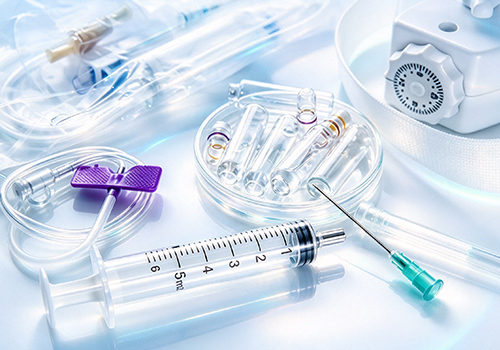
Medical catheter assembly involves multiple materials and structures: PVC catheters to PC connectors, TPU catheters to ABS fittings, fine needles to hubs, multi-lumen bifurcations. Each combination demands different adhesive performance.
Fundamental Differences Between the Two Adhesives
| Comparison | Medical Grade UV Adhesive | Instant Adhesive |
|---|---|---|
| Curing Trigger | UV light irradiation | Trace moisture in air |
| Transparent Substrate | At least one side transparent | No requirement |
| Curing Speed | 5-60 sec (light-dependent) | 3-20 sec fixture |
| Shadow Areas | May cure incompletely | Can cure |
| Biocompatibility Certification | ISO 10993-5 (ODAKE CT888 series) | Verify specific model (ODAKE CT883 meets FDA/REACH/ROHS) |
Cost of Wrong Selection
| Wrong Choice | Consequence |
|---|---|
| UV adhesive on opaque connector | Uncured shadow areas, leakage after sterilization |
| Standard UV adhesive on fast-cycle line | Cure wait time exceeds takt time |
| Instant adhesive without biocompatibility certification | Device registration materials rejected |
2. Market Context: Why Catheter Assembly Adhesive Selection Matters More Than Ever
Increasingly Precise Catheter Structures
Medical catheters are evolving from single-lumen to multi-lumen, from simple tubing to pre-assembled units with sensors and connectors. The more complex the structure, the harder for UV light to reach every bonding surface. Meanwhile, global medical device regulations continue to tighten biocompatibility requirements — ISO 10993 series testing is a mandatory threshold.
Industry Practice: Where UV Adhesives Fit in Catheter Bonding
In medical device assembly, UV-cure adhesives are typically used for catheter tip bonding, syringe and tubing connections, sensor housing assembly — applications sharing two characteristics: transparent substrates or UV-accessible paths, and the need for precise positioning before cure. Instant adhesives suit small-area, fast-positioning, no-UV-access assembly steps, provided the selected model has appropriate biocompatibility certification.
3. Solution: ODAKE Medical Grade Adhesive Selection
Option 1: Medical Grade UV Adhesive (First Choice for Transparent Substrates)
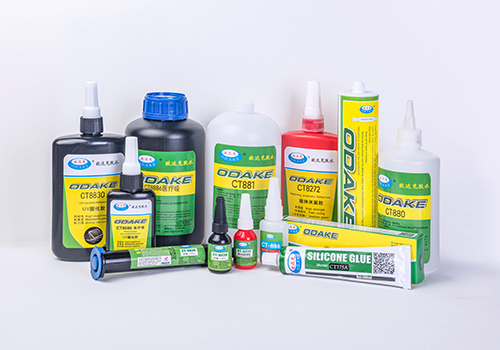
ODAKE CT888 series medical grade UV adhesives are ISO 10993-5 cytotoxicity tested (Labcorp report), suitable for medical devices in human contact.
| Model | Viscosity | Key Feature | Catheter Application |
|---|---|---|---|
| CT8887 | 350±50 mPa·s | Low viscosity, alcohol resistant, designed for PVC catheter/needle | Syringe needles, PVC fine catheter precision dispensing |
| CT8886 | 3,500-7,600 mPa·s | Medium viscosity, large gap filling, flexible impact-resistant | Catheter to connector (larger gaps) |
| CT8888 | 400-600 mPa·s | Low viscosity, fast cure (≤5 sec fixture) | High-volume production, fast positioning |
UV Adhesive Prerequisite: At least one side of the catheter or connector must be transparent (PC, PVC, clear ABS, etc.) for UV light to reach the bond line.
Option 2: Instant Adhesive (Opaque Structures or Fast Positioning)
ODAKE CT883 instant adhesive is based on ethyl cyanoacrylate, with shear strength ≥32MPa and 3-10 sec fixture. It is FDA, REACH, and ROHS certified, suitable for bonding silicone, TPE, and ABS.
Application: Catheter assembly involving opaque connectors, silicone seals, TPE tubing to rigid plastic connections, where fast positioning is required.
Selection Decision Tree
Medical Catheter Assembly Adhesive Selection
├── Is at least one substrate transparent?
│   ├── Yes → Medical grade UV adhesive (CT8887/CT8886/CT8888)
│   │   ├── Small gap/needle → CT8887 (low viscosity)
│   │   ├── Large gap/connector → CT8886 (medium viscosity filling)
│   │   └── High-volume line → CT8888 (fast cure)
│   └── No → Instant adhesive (CT883)
├── Need biocompatibility certification?
│   ├── Yes (human contact) → Confirm ISO 10993-5 report
│   └── No → Select by substrate and process
└── Is UV light access available?
    ├── Yes → UV adhesive
    └── No (shadow areas/opaque) → Instant adhesive or dual-cure
Key Reminder: Instant Adhesive Biocompatibility
When using instant adhesive in medical devices, the specific model’s ISO 10993 test data must be confirmed. Standard cyanoacrylates are not automatically biocompatible — suppliers must provide test reports for that specific formulation. ODAKE CT883 is FDA/REACH/ROHS certified, suitable for applications with safety requirements.
4. Summary
Medical catheter assembly — biocompatible UV adhesive or instant adhesive? Remember this formula:
Check substrate (transparent → UV, opaque → instant) → Check certification (human contact → confirm ISO 10993-5) → Check process (positioning needed → UV on-demand cure, fast takt → instant) → Check structure (shadow areas → instant or dual-cure)
ODAKE medical grade UV adhesives (CT8887/CT8886/CT8888) are ISO 10993-5 certified for transparent substrate catheter precision bonding; CT883 instant adhesive is FDA/REACH/ROHS compliant for opaque structures or fast positioning. For selection support for your specific catheter structure, contact us.