
5 Reasons UV Glue Won’t Bond PC Plastic | ODAKE UV Adhesive
Polycarbonate (PC) is tough, transparent, and widely used in medical devices, electronics, and optical parts. But when factories use UV glue, UV adhesive, or UV curing adhesive to bond PC, they often face weak bonding, peeling, cracking, or whitening. Based on ODAKE CT8888 technical data, here are 5 core causes and solutions.
Reason 1: Poor UV Light Transmission Through PC or Too-Thick Glue Line
Problem: The bottom of the adhesive does not cure, joints fail, or liquid remains inside.
Technical Cause: UV adhesives cure by ultraviolet light. Although PC is transparent, its UVA (365nm) transmission is limited. Thick glue lines, shadowed areas, or long lamp distance reduce UV energy at the bond line. CT8888 deep-section (1–3mm) curing requires 100mW/cm²@365nm for ≤60 seconds.
Solutions:
-
Keep glue line ≤1mm where possible;
-
Use 365nm UV lamp with 1000–3000mJ/cm²;
-
Use dual-cure systems for thick or shadowed areas;
-
Measure actual UV intensity with a radiometer.
Product Data: CT8888 initial cure: 30mW/cm²@365nm, ≤5s (PC-PVC); deep cure 1–3mm: 100mW/cm², ≤60s.
Certification: ISO10993-5 biocompatibility, suitable for medical devices、FDA
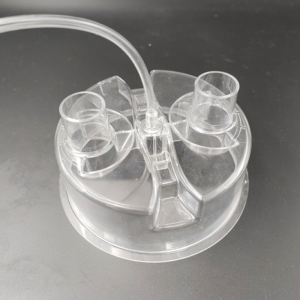
Reason 2: PC Stress Cracking Triggered by the Adhesive
Problem: Fine cracks, whitening, or breakage on PC after bonding.
Technical Cause: PC is sensitive to solvents and stress. Monomers, initiators, or cleaning agents in some UV adhesives can cause environmental stress cracking (ESC). Curing shrinkage adds internal stress.
Solutions:
-
Choose low-stress, flexible UV adhesives;
-
Avoid strong solvents (acetone, MEK) on PC; use IPA;
-
Avoid overly fast curing to reduce shrinkage stress;
-
Design joints with stress relief.
Product Data: CT8888 is a urethane acrylate with flexible, impact-resistant glue line; Shore D 62; temperature range -54 to 180°C; suitable for PC-PVC bonding.
Certification: ISO10993-5, medical device use、FDA
Reason 3: Surface Contamination or Mold Release on PC
Problem: Adhesive does not spread, edges lift, bond strength is low.
Technical Cause: Injection-molded PC often carries mold release, oil, or dust. These lower surface energy, preventing proper wetting and adhesion.
Solutions:
-
Clean PC with IPA or dedicated cleaner;
-
Use plasma/corona treatment to raise surface energy;
-
Ensure surface is dry and dust-free before dispensing;
-
Avoid touching bond surfaces by hand.
Product Data: CT8888 bonds plastic-to-plastic and many other substrates; stable on cleaned PC-PVC.
Certification: ISO10993-5、FDA
Reason 4: Insufficient UV Energy or Wavelength Mismatch
Problem: Tacky surface, uncured interior, low bond strength.
Technical Cause: UV adhesives need matched wavelength and sufficient energy. CT8888 cures by UV/visible light; best surface cure uses short wavelengths 220–260nm. Aging lamps, wrong wavelength, or short exposure cause undercuring.
Solutions:
-
Match lamp wavelength to adhesive initiator;
-
Check UV lamp intensity regularly and replace aging lamps;
-
Extend exposure time or increase intensity;
-
Use nitrogen inerting to reduce oxygen inhibition.
Product Data: Tack-free time: 100mW/cm², ≤20s; initial cure: 6mW/cm²@365nm, ≤15s (glass-glass).
Certification: ISO10993-5、FDA
Reason 5: Poor Joint Design — Gap Too Large or Too Small
Problem: Large gaps starve, small gaps under-fill; strength suffers.
Technical Cause: UV bonding needs proper glue line thickness. CT8888 is medium-viscosity with good gap-filling, but excessive gap reduces cure depth and strength; too small gap means insufficient adhesive.
Solutions:
-
Control gap per TDS; PC-PVC shear test uses 0.5mm gap;
-
Use higher-viscosity/filled UV adhesive for large gaps;
-
Use low-viscosity/penetrating UV adhesive for small gaps;
-
Dispense from one end to the other to avoid trapped air.
Product Data: Viscosity 400–600 mPa·s (Brookfield RVT, 25°C); specific gravity 1.02; refractive index 1.48.
Certification: ISO10993-5、FDA
-300x300.jpg)
Summary: 3 Reasons to Choose ODAKE CT8888 for PC Bonding
-
Flexible & Impact-Resistant: Urethane acrylate system for PC-PVC and other plastics;
-
Medical-Grade Certified: ISO10993-5, suitable for medical devices;
-
Fast Cure & Wide Temperature Range: Initial cure ≤5s (PC-PVC), -54 to 180°C.
If you are looking for UV glue, UV adhesive, or UV curing adhesive for PC plastic, ODAKE CT8888 is worth testing.
Contact: Hexu Xinwang Adhesives Co., Ltd., Dongguan City, Guangdong Province, China
.jpg)
.jpg)
主图-1.jpg)